26. Feb 2024
Article on the Topic: Turnkey Test Station
We at Robotec Solutions are proud that our innovative concept for turnkey solutions, handling stations, and test stations for an automotive supplier was featured in the renowned machinery market! Our customized solutions drive efficiency and precision in the automotive industry forward. Learn more about our groundbreaking technologies in the article.
"We have been developing robot-assisted automation solutions for high-tech industries such as medical technology, the watch industry, and the automotive industry for 40 years," says Jörg Lanz, Sales Manager for Germany, Austria, and Switzerland at Robotec Solutions AG in Seon (Switzerland).
The company's core competence is engineering know-how for demanding, turnkey installed, and validated manufacturing solutions with robotic handling, camera-based quality control, and all other necessary peripherals. Traditionally, mechanical engineering is characterized by dependence on hardware components and sequential workflows. Errors in engineering or unexpected errors during commissioning at the customer can cause high costs and delivery delays. Machine development with virtual commissioning, on the other hand, enables increasing parallelization of work steps. Using simulation, errors can be detected early in the product lifecycle.
The manufacturing of control cabinets and the mechanical structure, the connection of components via interfaces, and the development of the overarching software are fundamentally done in-house. For the additional hardware used, such as robots, machines, camera systems, and controls, Robotec is a certified partner of manufacturers like Fanuc, Stäubli, Omron, Siemens, and the camera manufacturer Cognex. With the help of these core components, fully automated complete solutions are created that meet the specifications developed jointly with the customer. In addition to their technical know-how, the developers also have the necessary knowledge in the area of legal and normative regulations and documentation requirements for the respective application area.
Injection Molding Handling Under Time Pressure
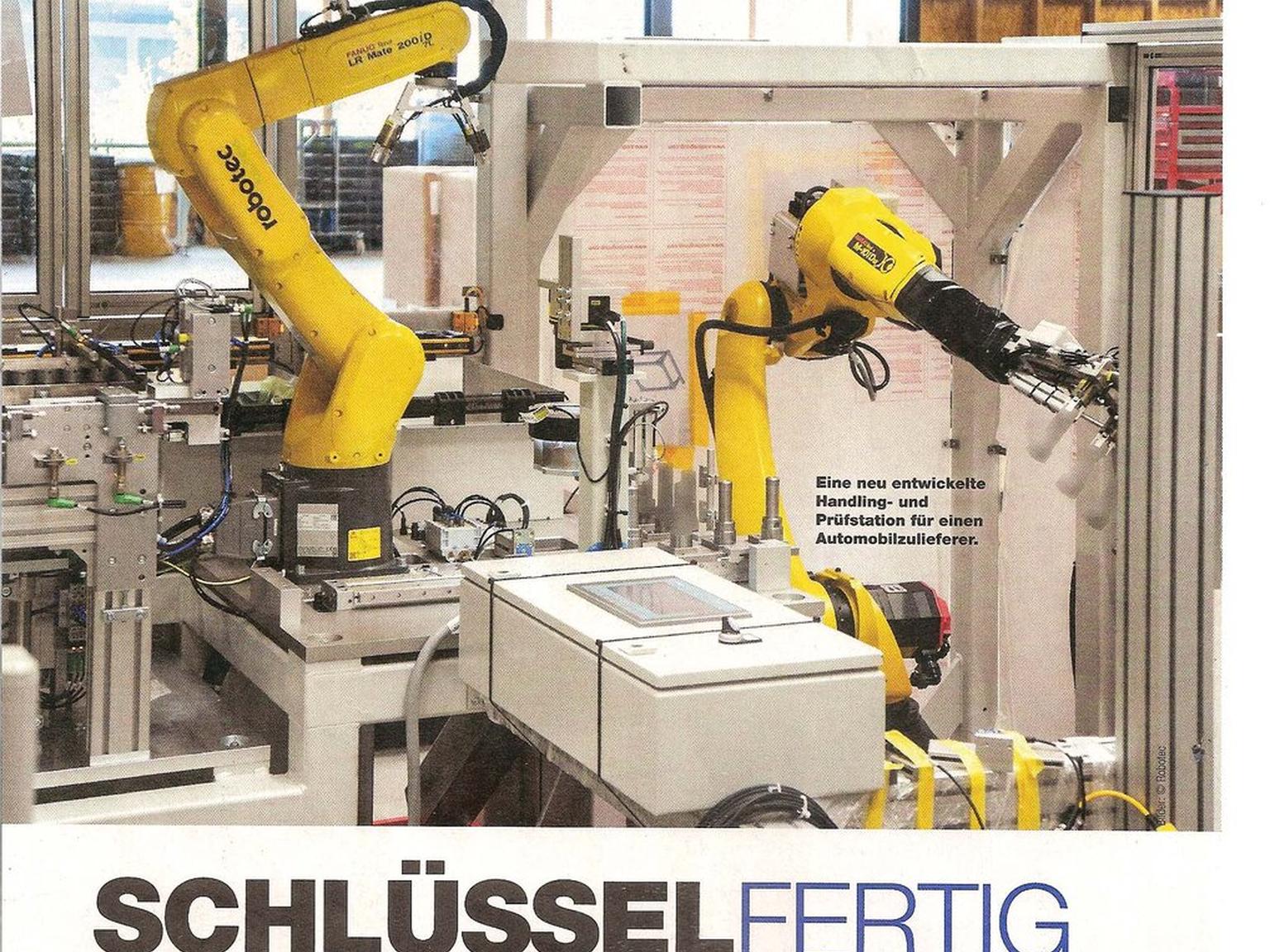
"Our customer Demmould GmbH is an innovative medium-sized supplier for the automotive industry," explains Lanz. In this case, it is about the plastic sheathing at one end of metallic guide sleeves. These cylindrical sleeves are about 100 mm long and have a diameter of around 15 mm over most of their length. Their narrow end is precision-machined and has a circumferential bead. At the other end, the sleeve is widened to about double the diameter. The narrow end of the sleeve is overmolded with an asymmetrically shaped plastic jacket in a four-cavity mold at Demmould. The solution required by Robotec includes the oriented feeding of the sleeves delivered as bulk material in the first step. The separation and orientation are done using a vibratory bowl. Subsequently, they are picked up piece by piece by the Fanuc robot "1" and placed on four receiving mandrels. From there, the robot "2" picks them up using its double four-finger gripper. With these four sleeves, it then moves in front of the open mold of an injection molding machine, where it first grabs four finished overmolded sleeves and simultaneously removes their sprues. Then it swivels around and inserts the four new sleeves into the mold. In the next step, it places the overmolded sleeves on the mandrels of a transport sled, which then moves them under the special camera for optical quality control one by one. Meanwhile, the next injection cycle already begins. The entire production cycle must not exceed 60 seconds, and the mold opening time is only 15 seconds.
Time-Critical Optical Quality Control
"The next and most demanding process step is the optical 360° inspection using a very complex camera and lighting system," adds Lanz. The camera features an optical system developed by Robotec itself with a sophisticated beam path, so that only a single photo needs to be taken for quality control. The image evaluation is done using AI software that was trained by Robotec based on a predefined selection of good/bad samples. In this optical inspection, in addition to checking the overmolded area, it is also ensured that there are no overmoldings at the upper or lower edge of the plastic jacket. The camera reports IO and NIO results during the further transport of the sled to robot "1", which accordingly places the overmolded sleeves either in an output box or in the reject container. Meanwhile, the receiving mandrels of the transfer station are again equipped with the next blanks. The program for the two robots runs on their own control, with one acting as master and the other as slave. Both robots monitor their work areas to avoid collisions with each other and with the separate handling system of the injection molding machine.
Customer Trust
"In the meantime, we have been able to realize more than 800 such robotic solutions in numerous countries," Lanz is pleased to say. Robotec now has service hubs in Germany and China in addition to its Swiss headquarters. A key factor in this success is the Swiss mentality of the company's management and staff: Accordingly, all systems are primarily about the reliability and quality of the delivered performance. The systems are designed for longevity and are characterized by high productivity and low susceptibility to faults in operational use.