24. Apr 2023
What is YOUR Thing?
This question was posed to our apprentice as a designer by the magazine Werkspuren. In this article, he was able to bring his chosen training closer to the reader. The trade magazine supports teachers with contextual knowledge in the fields of technology, textiles, and design. We care deeply about the education of the next generation, which is why we are all the more pleased about the article in the great magazine.
As a child, Jamie Dubs had a big dream: "I wanted to become an inventor!"
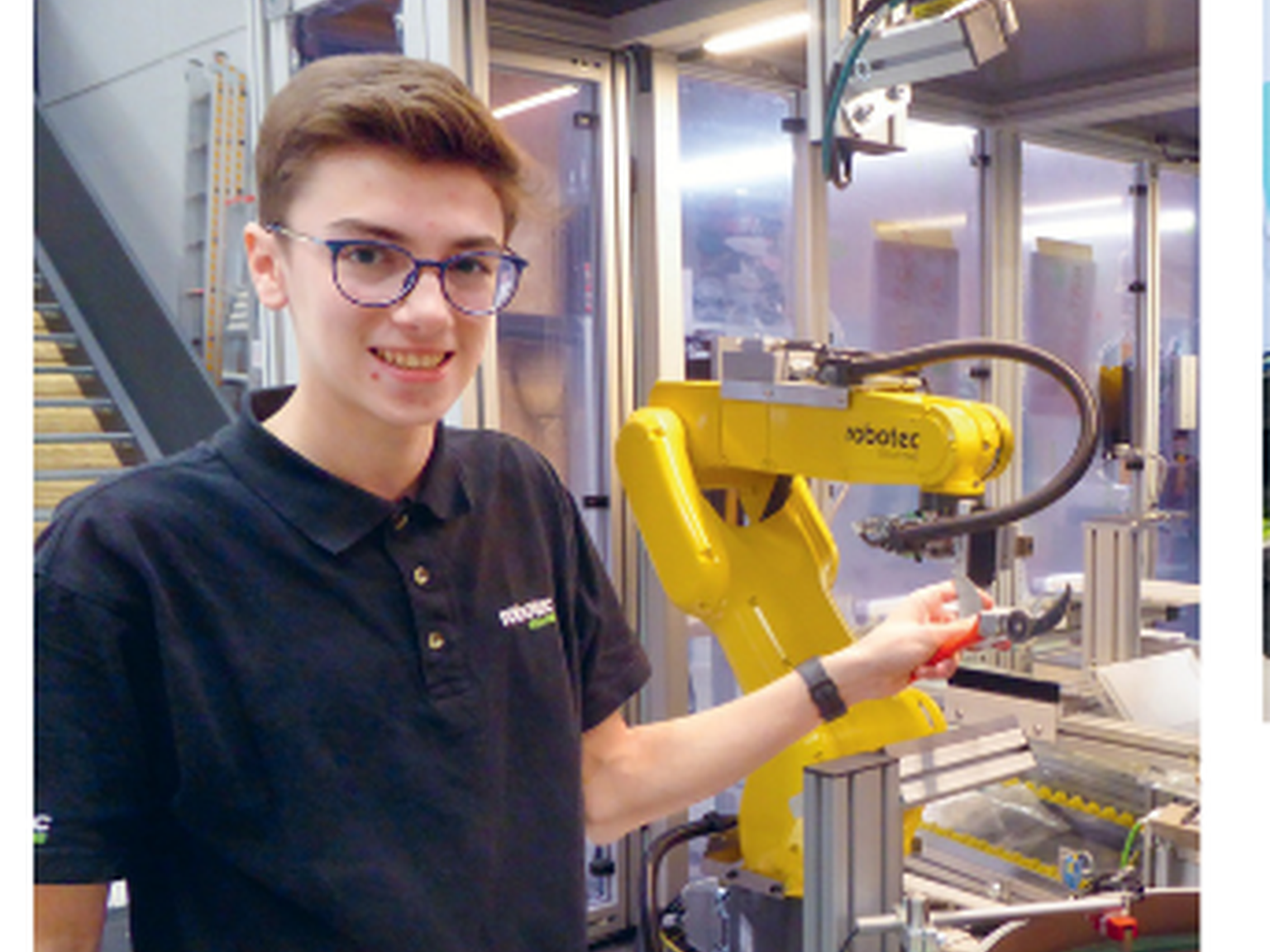
With an apprenticeship as a designer at robotec, he can turn his imaginative idea into reality. Visibly proud and skilled, he presents his first project to me: for a robot to inspect garden shear blades, he created the design drawings for a section of the gripper and "invented and built" a metal part for the hose holder in 3D mode. With the most important tool – a 3D mouse – Jamie navigates through a special CAD program and shows me all conceivable views of his design. Designers (de)construct their work into the smallest assemblies and then piece these puzzle parts together into a whole – geometric shapes, dimensions, and tolerances are meticulously calculated and documented.
Details about surface texture and materials are also recorded. Compared to the once manually created drawings, CAD allows for a detailed overview. Nevertheless, in his first two months in the inter-company courses, he still had to learn this manual work. That will likely change in the future.
In the huge workshop, countless yellow robots stand, and I encounter the virtual gripper in reality: for safety reasons, the robot is housed in a transparent "cell." Robotec specializes in customized gripper solutions; the actual robots are purchased. Jamie is fascinated by the innovation potential of the "robot hands." These move like the human hand on six axes. Thanks to specialization and optimization on a partial movement, they maximize efficiency in industrial manufacturing processes. They must be repeatedly adapted to new requirements – one of the main tasks of designers at robotec.
"The designer is a kind of hinge in the company – if they design something incorrectly, it has massive impacts on execution." Therefore, teamwork is central: with polymechanics, automation technicians, plant and apparatus builders, and electronics technicians. Since Jamie is also skilled in 3D printing, he is allowed to print his prototypes himself. "I was always a clever tinkerer. In the 6th grade, the workshop teacher devised an additional task for fast students: Whoever gets a free, defective pocket bike from Ricardo running can keep it. I solved the problem in no time..."