27. Mar 2023
Flexible, Adaptable, and Efficient: Cobots in Manufacturing
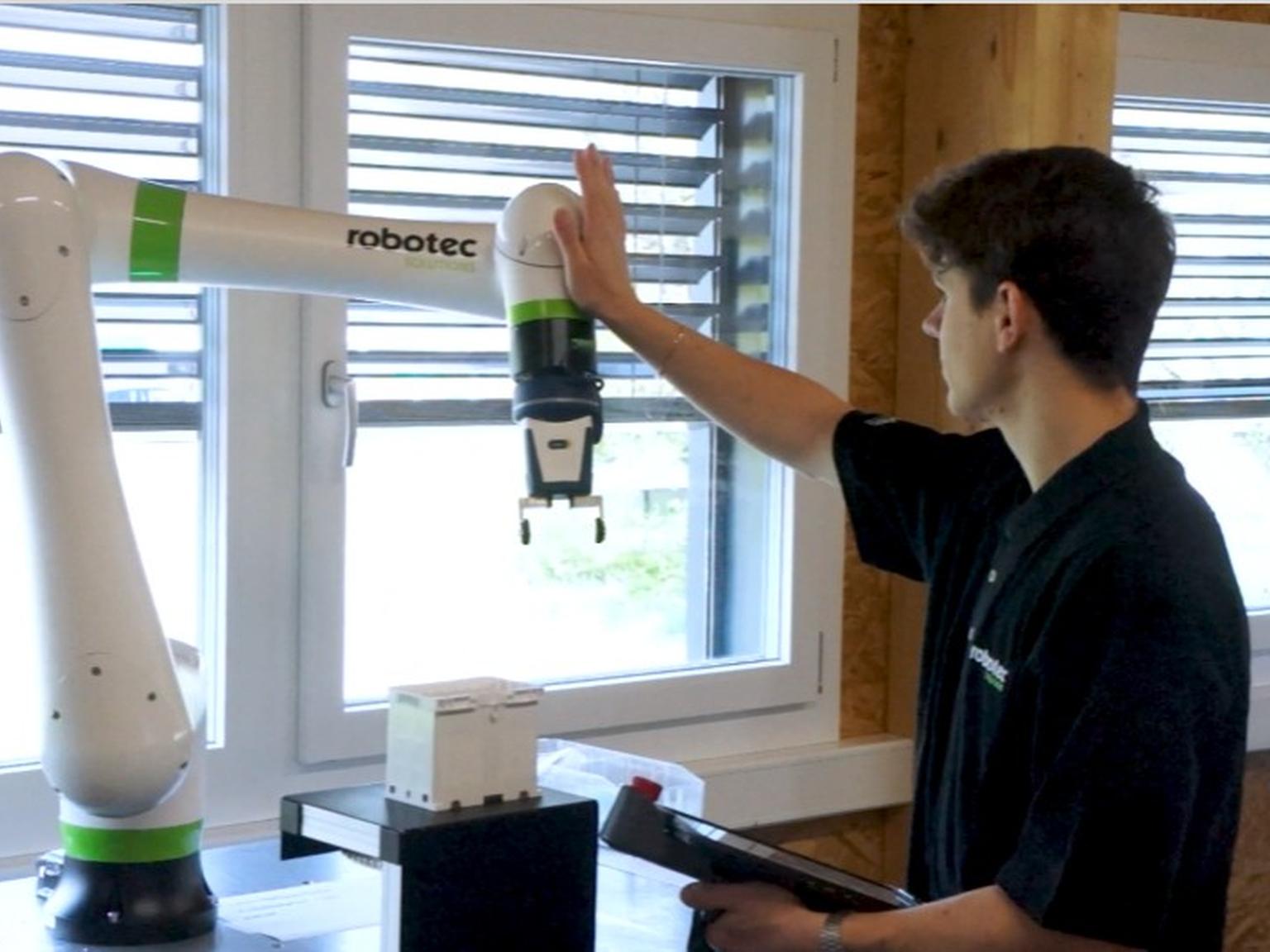
The workplace of the future is a place where humans and machines work hand-in-hand. Collaborative robots are industrial robots that work with people without mechanical safety devices and are not separated from them in the production process.
The system is very flexible and can be used in various areas. The division of labor between humans and machines can be redesigned so that the robot takes over monotonous, dangerous, or physically demanding tasks, while the employee can focus on demanding assembly work and targeted troubleshooting. In human-robot collaboration (HRC), safety systems play an important role.
The reach of a cobot ranges from 944 mm to 1889 mm, and it handles a payload of 5 to 25 kg. With customized platforms for stabilization and adjustment of the workplace, the cobot can be adapted to the corresponding needs. Although cobots are designed to work with humans, safety with collaborative robots must be checked according to EN ISO 10218, Part 1, 2, and ISO/TS 15066.
How can I achieve risk reduction in human-robot collaboration (HRC) according to EN ISO 10218-2 and ISO/TS 15066?
Method: Safety-oriented stop (Co-existence)
Upon entering the collaboration area, the robot is in safe operational halt. Upon leaving this area, the robot resumes its movement either by acknowledgment or automatically. The speed is determined based on the risk assessment.
Hand guidance (Sequential cooperation)
The human may only approach the stationary robot. By activating the enabling device, the robot can be manually guided at a safe, reduced speed. The speed is derived from the risk assessment.
Speed and distance monitoring (Parallel cooperation)
Non-separating protective devices are used so that people can approach the robot at any time without danger. The distance between human and robot is monitored, and the speed is adjusted accordingly. Before a collision occurs, the robot shuts down.
Power and force limitation (Collaboration)
A collision between human and robot is possible under compliance with biomechanical limits. A combination of different methods is possible, such as combining methods 3 and 4.