23. Jan 2023
Assembly Automation System for Thousands of Connector Types
“Can you develop a system that automates the production of a wide range of different connector types?” With this request, Fischer Connectors approached us at the beginning of 2022, launching an exciting and challenging project.
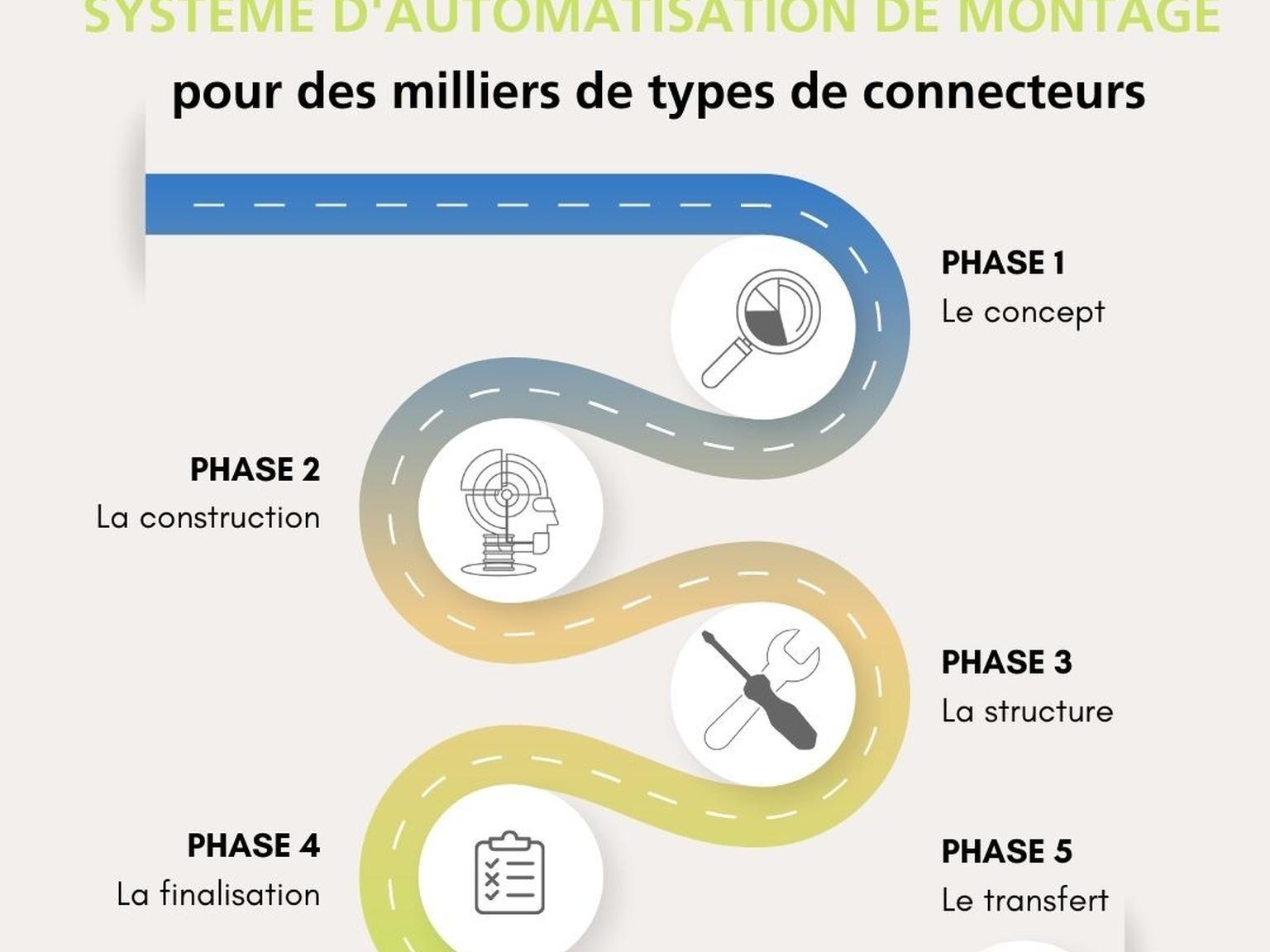
The company Fischer Connectors regularly requires various types of connectors. Assembling all of these by hand is a tedious and time-consuming task. Therefore, in the future, an assembly automation system should take over this task. Since Fischer Connectors already has three systems from Robotec Solutions in operation and is very satisfied with them, the company also entrusted us with the development and production of this fourth and fifth system. The 5 phases of the development process could thus begin...
Phase 1: The Concept
At the beginning, we sat down with the responsible parties from Fischer Connectors and exchanged ideas about the wishes for the assembly automation system. Based on the requirements catalog, our sales team then created the rough concept, which was subsequently discussed in a kick-off meeting together with the customer and our engineering department. Among other things, the following four challenges were the focus:
- The robot system should cover an enormous variety of types.
- The execution had to be absolutely precise and accurate to five hundredths of a millimeter.
- The cycle time should only be 7 seconds per contact.
- The system should be easy for the customer to operate so that, in addition to the 12 connectors already programmed by Robotec Solutions, they can program new connector types at any time with as few parameters as possible.
Phase 2: The Design
After the order was placed, the sales team handed the project over to the engineering department, which worked out a rough design. Once Fischer Connectors approved this, the detailed design could begin. During this phase, there was an exchange with the customer every two weeks. This allowed us to regularly inform them about the current status and give each other feedback on the ongoing project. At this time, individual tests were already being conducted at Robotec. For example, it was checked whether the camera delivered the desired images and whether the lighting was correct. Last but not least, parts lists were already generated, and the ordering of components began so that we could start building on time.
Phase 3: The Assembly
After the detailed design was completed and all materials were ordered, the design team met with the assembly team for the handover. Then the mechanical part could start – the assembly of the automation system. At the same time, offline programming also began. When the system was about 75 percent complete, the responsible parties from Fischer Connectors were invited to inspect the system. This allowed the customer to get a first feel for the system, ask questions, and, if necessary, make small change requests.
Phase 4: The Finalization
After the assembly team had completely set up the cell, they handed the system over to our software department. They could now load the prepared offline programming onto the system, actively test the cell for the first time, and eliminate any errors. Subsequently, the team from Fischer Connectors visited us again to accept the system. During this process, it was tested whether the assembly automation system met all criteria such as cycle time, product variety, and ease of use. This process is called FAT – Factory Acceptance Test – and usually lasts one to two days.
Phase 5: The Handover
The customer has now given us the go-ahead for delivery. In March, we will transport the system to the headquarters of Fischer Connectors in Saint-Prex. After commissioning, training and the SAT, the Site Acceptance Test, will take place at the customer.
Technical Details of the System
- Space requirement for the cell: 2 x 1 meter
- 3 robots: 2 six-axis articulated robots and one SCARA robot
- 9 complete vision systems from Cognex
- The system produces up to 1,000,000 connectors per year
- For the period 2020 - 2022, they produce around 1,400,000 connectors with the 3 existing cells
- Enormous variety of types: 270 connector types have already been programmed by the customer with the existing cells